Though the shape of a solution to the showdown is still unclear, and the Kremlin continues to push for security guarantees that the US and NATO have called non-starters, Macron said that he and Putin were beginning to build a “constructive arrangement,” which was “mutually acceptable” to Russia and the rest of Europe to “help us avoid war.”
“This dialogue is absolutely essential, more than ever, to ensure the stability and security of the European continent,” Macron said in remarks aired on Russian state television at a meeting soon after he arrived at the Kremlin.
Putin said the two countries shared “common concern” about the security situation in Europe. “I see how much effort the current leadership of France and personally the president of France are making to resolve the crisis associated with ensuring equal security in Europe,” he added, shorthanding the issue as “the resolution of the intra-Ukrainian crisis,” a phase that casts the conflict in Donbas as a purely internal matter of Ukraine and avoids mention of Russia’s role in it.
Ahead of the meeting, German Foreign Minister Annalena Baerbock said its government was prepared to enforce “unprecedented sanctions” on Russia if the Kremlin fails to de-escalate tensions with Ukraine, adding that the “ball is firmly in Moscow’s court.”
“We will do everything to ensure that there is no further escalation. We have therefore jointly prepared a series of tough measures against Russia for this eventuality,” Baerbock said.
“These unprecedented sanctions have been coordinated and prepared with the approval of all partners,” she added.
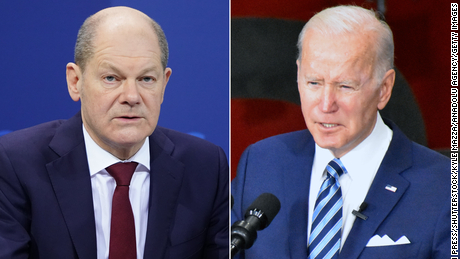
Scholz, who succeeded Angela Merkel in December, has taken a softer approach on Russia than the US and its allies. Germany has not joined the US, France, Spain and other allies in bolstering troops along NATO’s eastern flank. It has also been reluctant to provide lethal aid, refusing to allow NATO ally, Estonia, to send German-made howitzers to Ukraine and drawing mockery for sending thousands of helmets instead of weapons.